
Brick by Brick
On Turning 26, Exhausted, and Starting Over

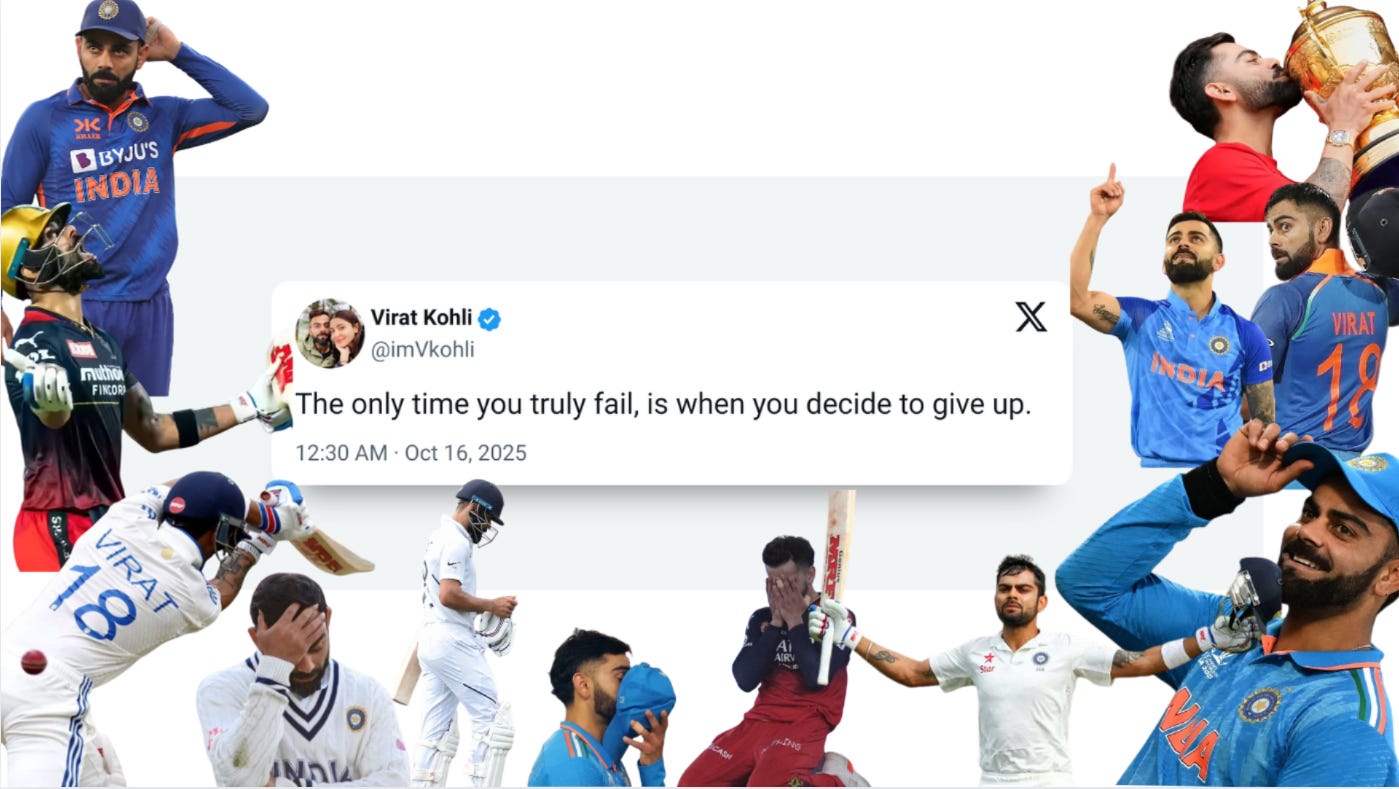
Lord’s, July 2014
It’s a bright Saturday morning at Lord’s. Around 28,000 people in the stands. A polite yet electric buzz fills the air as India holds a narrow lead after England’s first innings. The pitch had started green, dangerous. India’s at a great start - 118 for 2.
Walking out to bat at No. 4 is 25-year-old Virat Kohli. India’s brightest young batting talent. The “next Tendulkar.” The future of Indian cricket. Before the series, he’d been praised for his aggression, confidence, consistency.
The atmosphere is taut with expectation. He’d made a modest 25 in the first innings, nicking behind to Anderson. Pressure was mounting. Spectators lean forward, murmuring.
Liam Plunkett comes running in, angles one towards off stump. Kohli expects it to hold its line, only to see the ball jag up the slope and clip the top of off stump. A cruel betrayal of judgment.
Bowled. Zero. Golden Duck.
The crowd gasps, then applauds politely. Kohli turns, shoulders tight, unable to hide his disbelief. India’s dressing room balcony falls silent.
39, 28, 0, 7, 6, 20 - those were his scores for the rest of the tour. Just 134 runs across 10 innings in five Tests.
Analysts were brutal. “Technically flawed.” “Mentally uncertain.” A player who had “lost his credibility as a Test batsman in just one month.” Some wrote he might become “a pushover in Test cricket.”
What they didn’t know was this: the 25-year-old walking off that day, considered just another batsman who couldn’t handle overseas conditions, had just ignited one of the most powerful comebacks modern cricket would ever see.
The Checkpoint
I turned 26 today.
Not with fireworks or plans or excitement, just with this quiet, uncomfortable awareness that 25 was supposed to feel different than this.
I graduated with a master’s degree. I moved three times since July. My friends are scattered across cities and time zones. I clock in and out of work, running on autopilot, already worried about what my next actual job is going to be. What I’m even going to do in the future. Where I’m headed. What my destiny is.
If there even is one.
I’m not failing. I’m just... floating. Professionally. Personally. Emotionally. The kind of tired that sleep doesn’t fix. The kind of overwhelmed that makes you hard on yourself for feeling overwhelmed in the first place.
25 was supposed to be the year things clicked. Instead, it was the year I stopped recognizing myself.
So 26 isn’t a celebration. It’s a checkpoint. A mirror I didn’t ask for but can’t ignore.
And when I look in it, I don’t see the person I imagined I’d be by now. I see someone else, someone going through the motions, someone I don’t quite recognize. And that sits uncomfortably with me.
Because I know I didn’t come this far to just be... this.
The Mirror
There’s this 5’8” guy from West Delhi who smiles too much, giggles with his teammates, and is very curt in press conferences. He also happens to be one of India’s best Test captains and the greatest run-chaser across all formats.
Yes, of course it’s Virat Kohli.
Years after that England tour, he admitted he was “insecure, nervous, and tense” during that period. Not just about his performance, but about whether he was actually good enough.
I’m not comparing our struggles. He’s a world-class athlete; I’m just trying to figure out what’s next after grad school.
But I get it. That feeling of not recognizing yourself. Of people (or worse, you) forgetting who you are because of what’s not clicking right now. Of being in the middle of something with no clear way forward.
He was my idol before. Now he’s my mirror
The Rebuild
What Kohli did next wasn’t dramatic. It wasn’t a montage. It was just... work.
After that England tour, he didn’t make excuses. He looked at himself honestly and realized he’d gotten complacent. He’d forgotten the basics. So he rebuilt from scratch. Changed his training. Changed his diet. Made it an obsession.
But the thing that stuck with me wasn’t the technique. It was what he said about hitting rock bottom:
“Once you’re down and out, no one comes to help you. They just attack you. So why do I need to prove anything to them? They have nothing to contribute. I’ve hit rock bottom. No one believes in me to play Test cricket. So I’ll work as hard as I can.”
That’s the part that resonates. When you’re struggling, you realize how much energy you’ve been spending trying to prove yourself to people whose opinions don’t actually matter. And at some point, you have to stop performing for an invisible audience and just... work. For yourself. Because you can’t live with the alternative.
He put it simply: “There have always been two options: fight or flight. I’ve never taken flight. You can take flight, but if you can’t sleep peacefully at night, it’s not worth it. Even if I failed, I’d know I took the right option. That gives me peace.”
I think about that a lot lately. The peace that comes not from winning, but from knowing you didn’t quit. From knowing that when you clock out each day, you gave it your all.
The Audacity of Hope
I’ve been reading Barack Obama’s A Promised Land lately, and there’s this line that keeps coming back to me:
“Hope is not the blind optimism that ignores difficulty, but the audacious belief that we can shape our own future.”
The audacity of hope. Not naïve optimism. Not pretending everything will work out. To keep showing up, not because success is guaranteed, but because you refuse to stop believing that it’s possible.
That’s what Kohli embodies. He talks about failure honestly. “Do I get affected by failure? Yes. I’m human.” He admits the hurt, the doubt, the difficulty of processing failure on the biggest stage.
But then he says something that shifts everything: “You need to feel the hurt, introspect, see where you went wrong. But you can’t beat yourself down so much that you cannot get up again. Life is about making mistakes regularly and having the courage to accept them without being egoistic. Lay it down, see how you can improve, and walk forward.”
Hope isn’t passive. It’s not waiting for the spark. It’s a verb. It’s discipline. It’s striking the match every morning, even when nothing feels certain.
Brick by Brick
25 was loud. New York, late nights, stories on stories, almost getting impeached as VP of student council in my final week (yeah, that happened) because of course. Everything I wanted until it ended.
But 26? 26 is reconstruction.
I’ve been given opportunities most people would want. I’m in a situation most people would consider enough. But I can’t accept “enough” when I know there’s more I’m capable of. I’ve been blessed with a healthy mind and body, and I need to be honest about that. To accept what I’ve done wrong. To be honest enough to acknowledge it and disciplined enough to change it.
Kohli talked about something that resonates: competing with yourself, not comparing yourself to others to prove them wrong. Not measuring yourself against expectations or timelines or the version of yourself you thought you’d be by now.
Just against yesterday’s version of you.
Maybe that’s what 26 is. Not about having all the answers, but having the audacity to keep trying everyday.
I don’t know if I’ll become great. But I know I can’t live without trying.
This year, I’m not quitting. Not on this. Not on myself.
So I’m rebuilding. One day at a time. One brick at a time.
Virat Kohli’s quotes are drawn from various interviews, podcasts, and public statements.
Man this hits so hard. The feeling of floating and the scary feeling of not knowing what is next and where to go. Love the Kohli parallel too. He's been a pillar of perseverance and hard work for as long as I can remember.
Your post kinda reminds me of a quote by Max Holloway: "If you give up, you're a certified loser. If you try you're at least a winner in your book"